Mapping research on climate change adaptation since the beginning of the 21st century
How
Scope, corpus definition, and project context.
Where
Geographical patterns in publications and doctoral research.
Which organizations
Leading institutions and organizational networks.
Which topics
Main thematic structures and their evolution over time.
How?
Defining the study boundaries
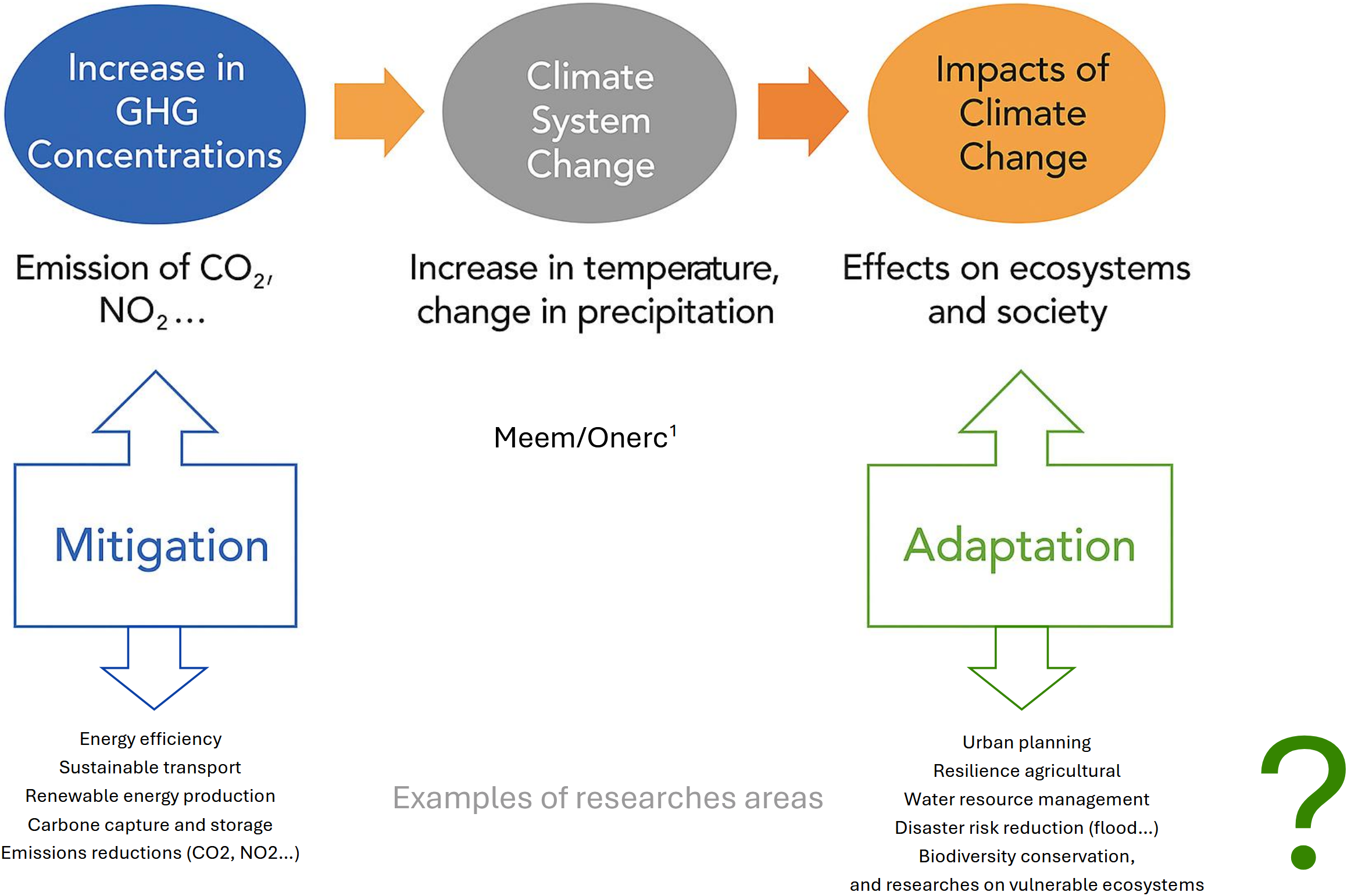
The impacts of climate change on our lifestyles and forms of organization constitute, and will continue to constitute, a major challenge of the 21st century. Mitigation and adaptation measures are two key areas under research and reflection in public policy-making. National frameworks are being developed to support these adaptive measures, in order to limit the expected impacts of climate change on socio-economic activities, species, natural environments, and ecosystems.
Scientific publications insights
TS=("adapt* to climat* chang" OR "adapt climat* chang" OR "adapt for climat* chang" OR "climat chang* adapt" OR "adapt to climat" OR "adapt climat" OR "adapt for climat" OR "climat adapt*") AND PY=(2001-2024)
Filter: Scientific journal, book chapters, proceeding paper
21,078 results from Web of Science Core Collection
French doctoral research fronts insights
https://theses.fr/api/v1/theses/recherche/?q=("adapt* to climat* chang" OR "adapt climat* chang" OR "adapt for climat* chang" OR "climat chang* adapt" OR "adapt to climat" OR "adapt climat" OR "adapt for climat" OR "climat adapt" OR "adaptation au* changement* climatique" OR "adaptation changement* climatique" OR "adaptation pour le* changement* climatique" OR "adaptation au* climat" OR "adaptation climatique" OR "adaptation pour le climat" OR "climat adaptation*")
Filter: first enrollment or thesis defended between 2001 and 2024
380 PhD theses:
- 165 with status "en cours" = thesis currently being processed by the awarding institution. Not yet archived, not yet accessible online or in the institution’s library, and the description on theses.fr is not yet finalized.
- 215 with status "soutenue" = defended thesis, archived, and fully referenced on theses.fr.
How?
Project team
IT development
data collection, interface development, administration and maintenance
Philippe Breucker (INRAE): technical director
Victor Pesneaud (Fondation Université Gustave Eiffel): front end
Diego Gomez (Fondation Université Gustave Eiffel): front end, data management
Joenio Da Costa (UGE, I-Site Future): server and service administration, maintenance with the DGDIN
Startup Cogniteva (https://cogniteva.com/, IA et LLM)
Results interpretation
study scope, analysis and interpretation of results, metrics and indicators, interface specification
- Marc Barbier (INRAE)
- Géraldine Enderli (INRAE)
- Lionel Villard (ESIEE Paris, UGE)
The project is conducted in collaboration with several academic and technical partners. It relies on the CorText platform (https://www.cortext.net), developed within the LISIS laboratory (https://umr-lisis.fr/) and supported by INRAE (https://www.inrae.fr). The work also involves Université Gustave Eiffel (https://www.univ-gustave-eiffel.fr) which contribute to the maintenance of the technical infrastructure.
This work has been founded by Université Gustave Eiffel Foundation (https://fondation.univ-gustave-eiffel.fr/qui-sommes-nous).
Where
Scientific publications: mapping countries, cities, and collaboration networks
Where
- Scientific publications: mapping countries, cities, and collaboration networks
- French doctoral theses: mapping institutional linkages across territories
Which organizations
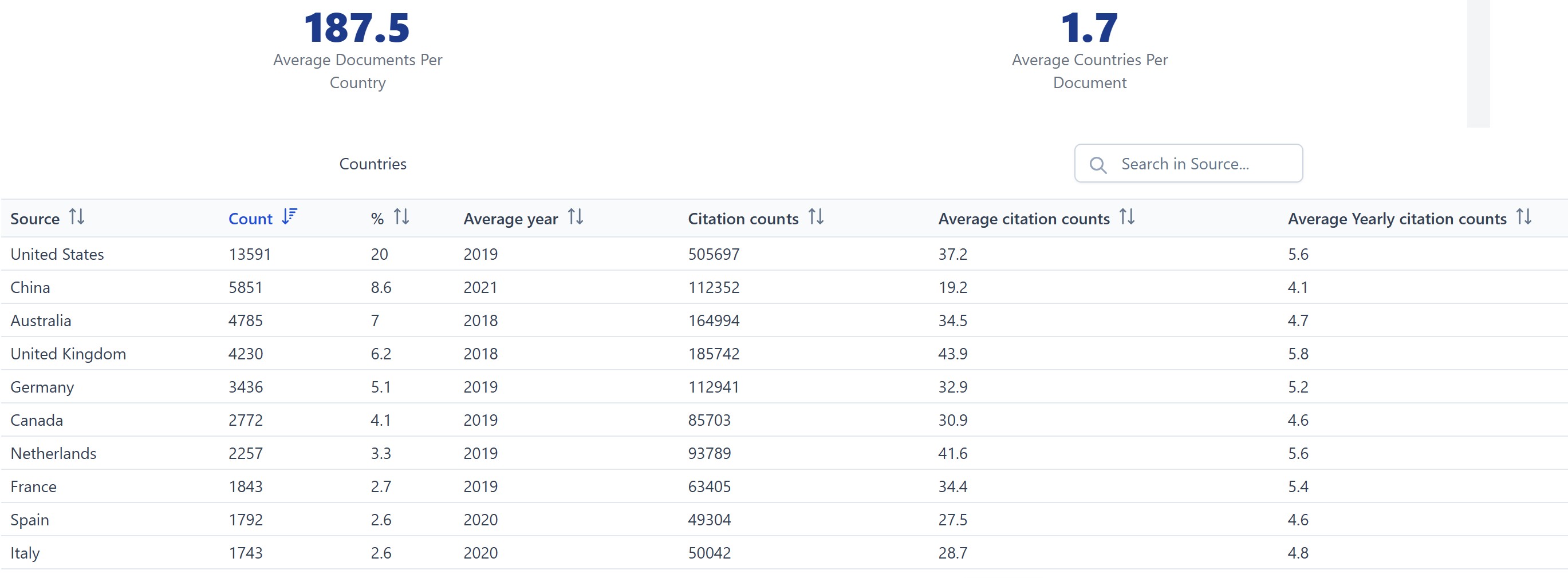
Ranking of top 10 countries

In terms of volume, U.S. researchers have published far more than those of any other country. China ranks second, and the average publication year shows that it has entered this research field more recently. The citation rates normalized by year indicate a strong impact of research produced in the USA and the United Kingdom. France is not far in terms of scientific impacts.
Research intensity of cities within the field
International collaboration network between cities
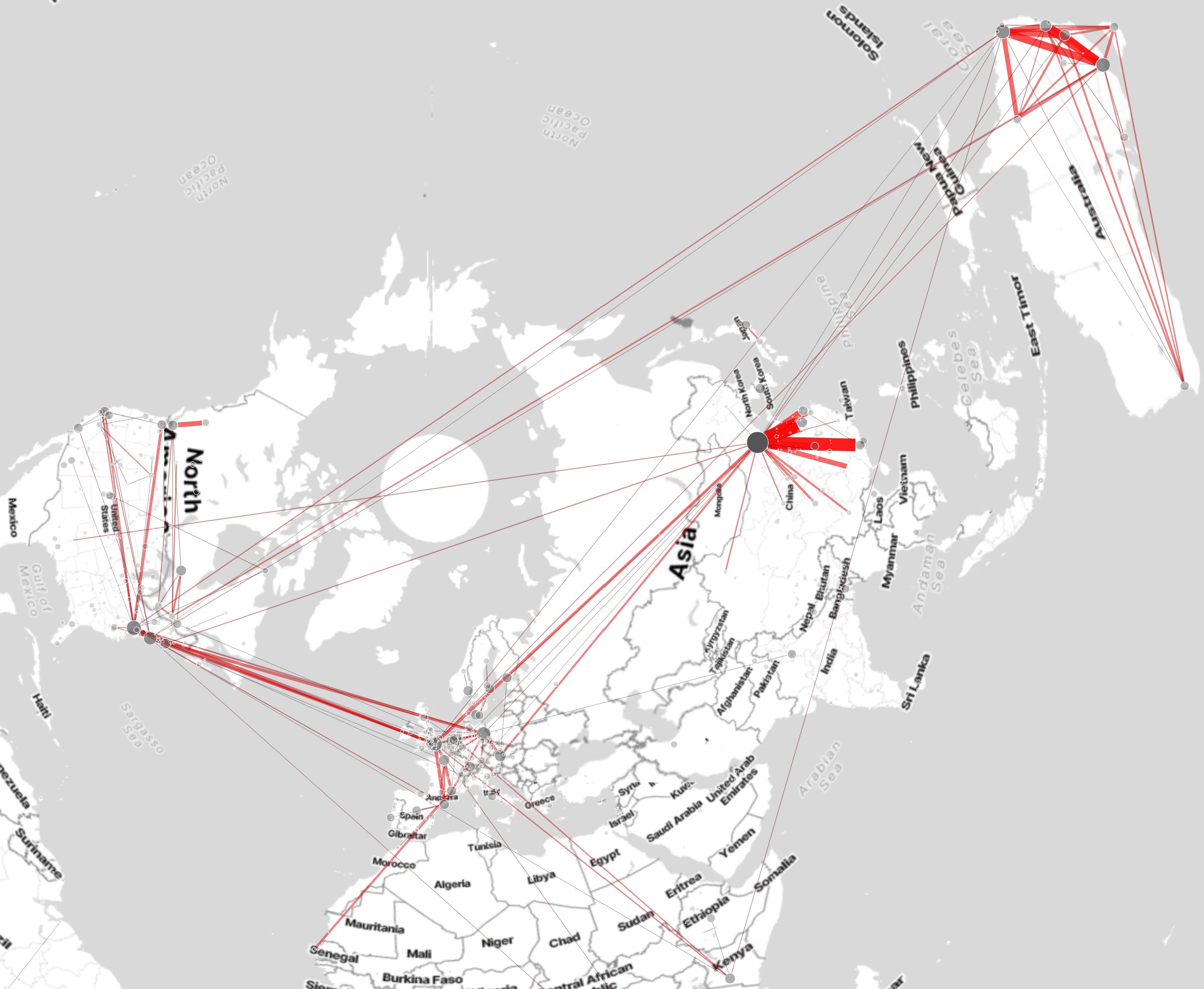
A significant and highly structured national collaboration network in China and Australia.
Weak collaboration links between China and the United States. New York, Boston, and Washington serve as entry points for European collaborations.
Arabesque (arabesque.univ-eiffel.fr)
French collaboration network between cities
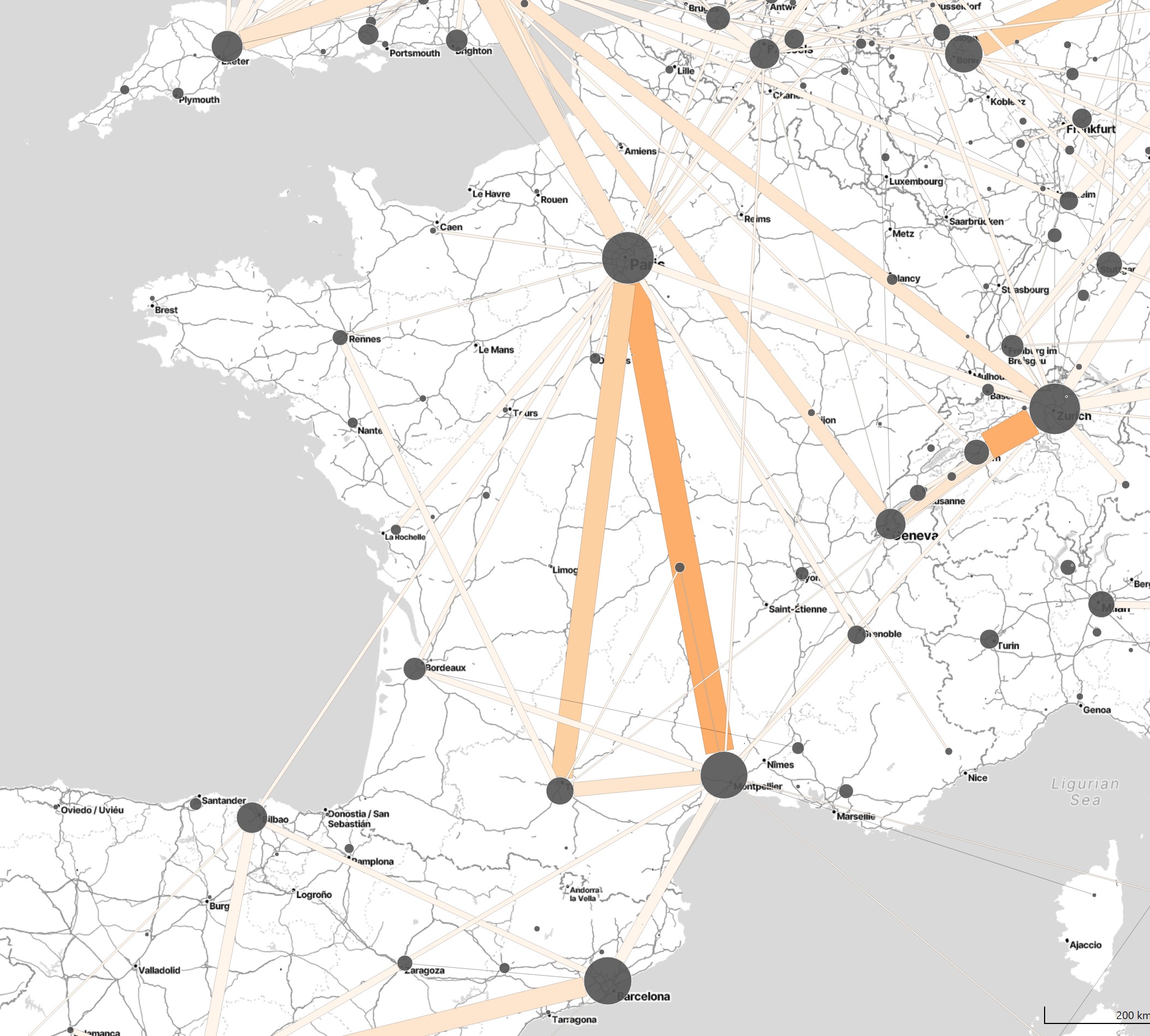
A structuring triangle: Paris, Montpellier, and Toulouse.
Along with major regional cities such as Grenoble, Bordeaux, and Rennes.
Arabesque (arabesque.univ-eiffel.fr)
Where
French doctoral theses: mapping institutional linkages across territories
Where
- Scientific publications: mapping countries, cities, and collaboration networks
- French doctoral theses: mapping institutional linkages across territories
Which organizations
PhD institutional linkages: a national perspective
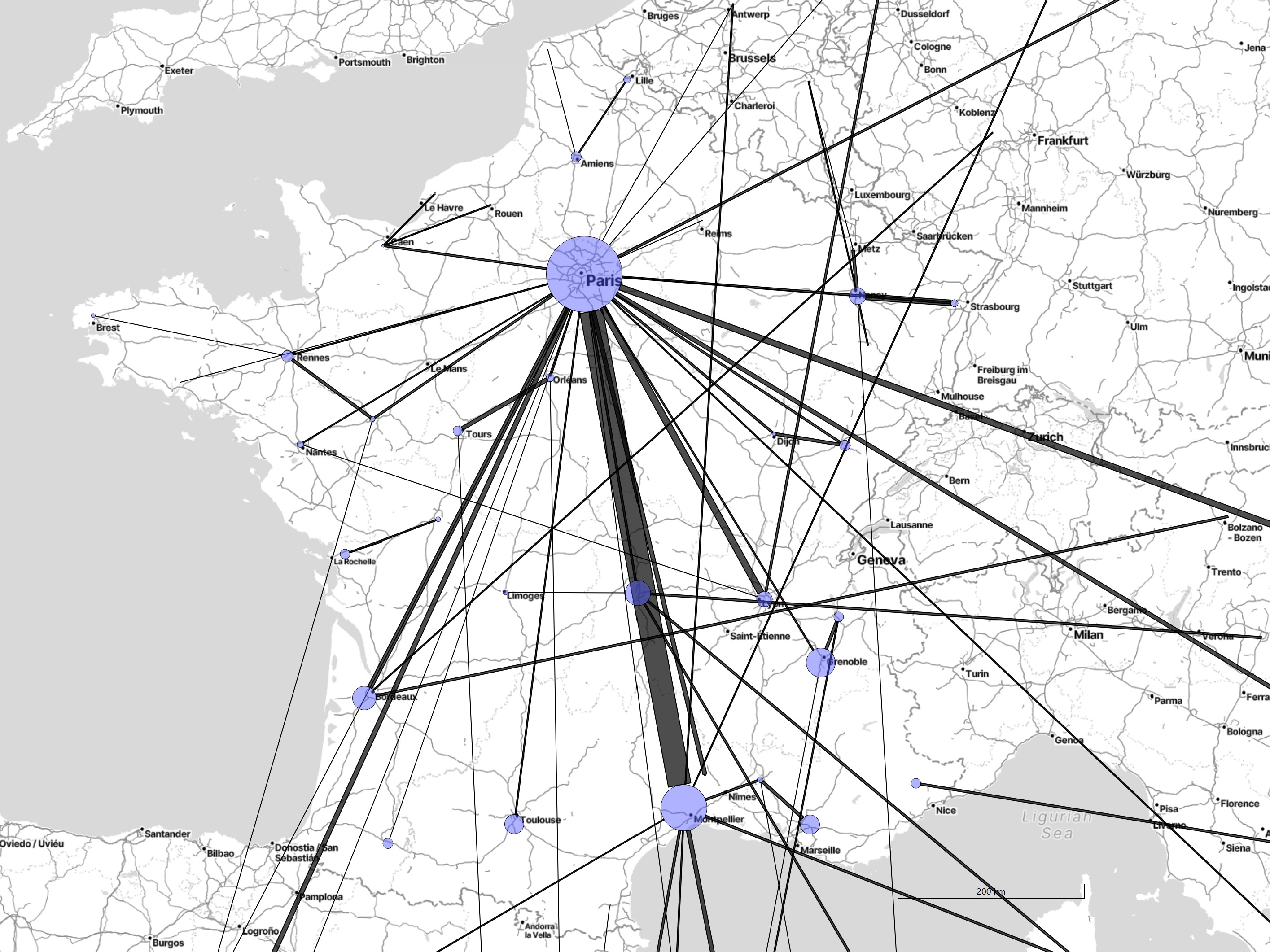
A star-shaped network connects Paris. But Montpellier plays an important role in PhD theses on climate change adaptation, just ahead of Grenoble (while Lyon and Marseille are not very active). Amiens (26), Rennes (32), Tours (24), Marseille (68), Grenoble (138), Besançon (28), Nancy (52), and La Rochelle serve as strong regional hubs connecting nearby cities. Arabesque (arabesque.univ-eiffel.fr)
PhD institutional linkages: a local focus
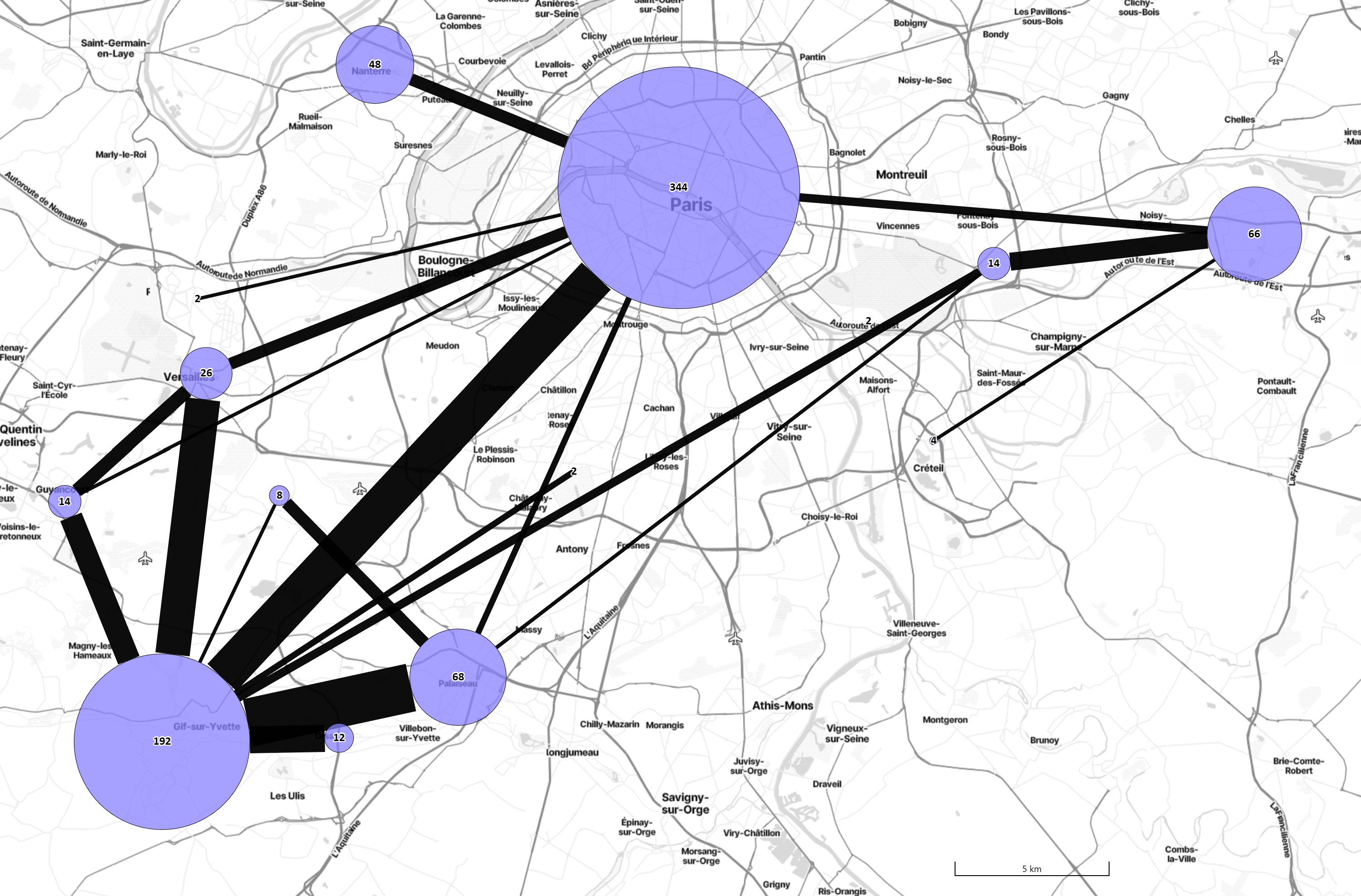
At the municipal scale in Île-de-France, the universities and research organizations in Paris and Saclay structure the institutional frameworks of PhD theses.
The Université Gustave Eiffel campus also plays an important role in hosting doctoral students working on these topics.
Arabesque (arabesque.univ-eiffel.fr)
Which organizations
Scientific publications: identifying leading organizations and collaboration patterns
Where
Which organizations
- Scientific publications: identifying leading organizations and collaboration patterns
- French doctoral theses: identifying leading universities and institutional linkages
Ranking of top 10 organizations (dashboard)
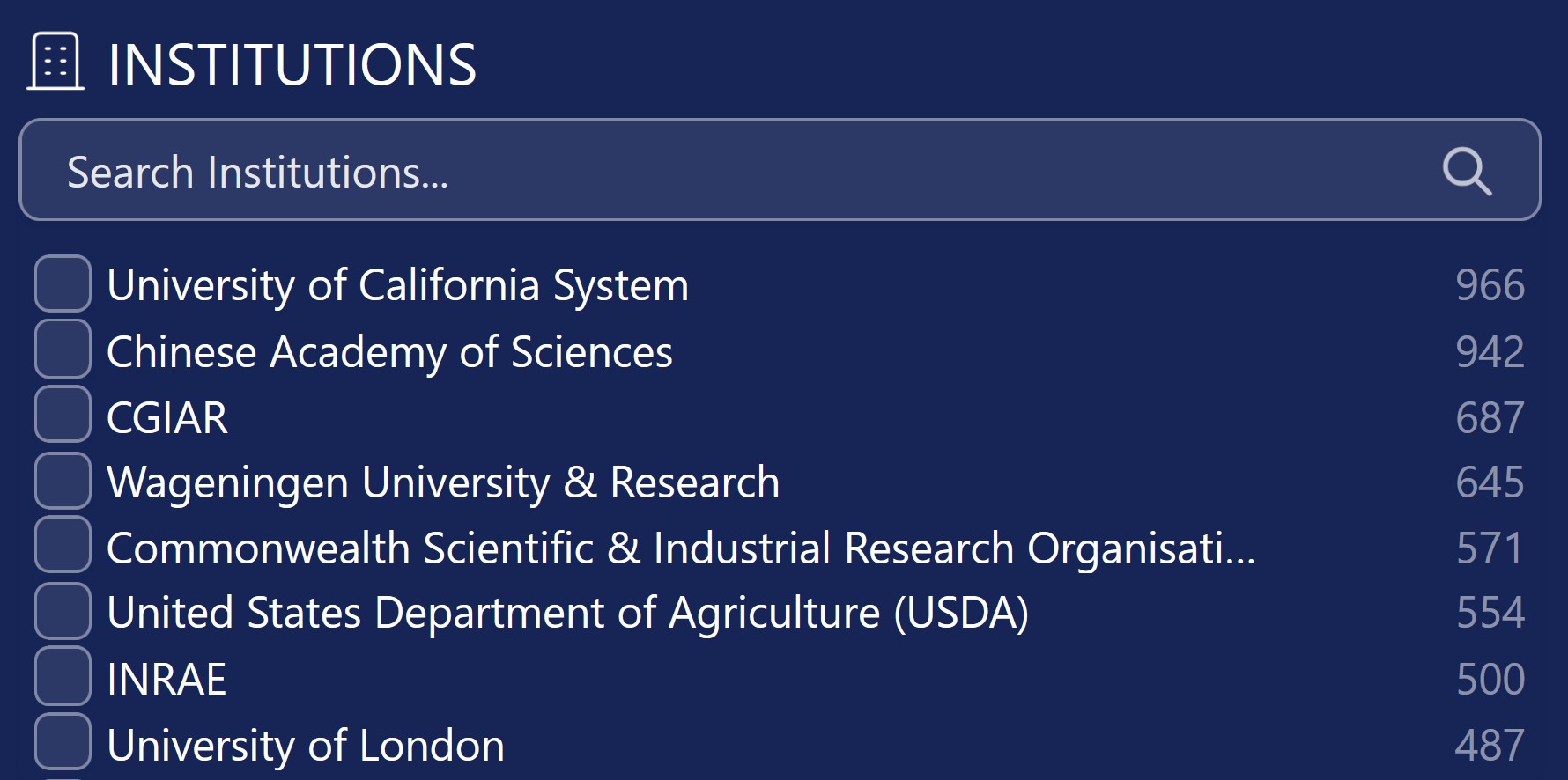
Two top research organisations, in the USA and China.
Ranking of top 20 organizations per periods
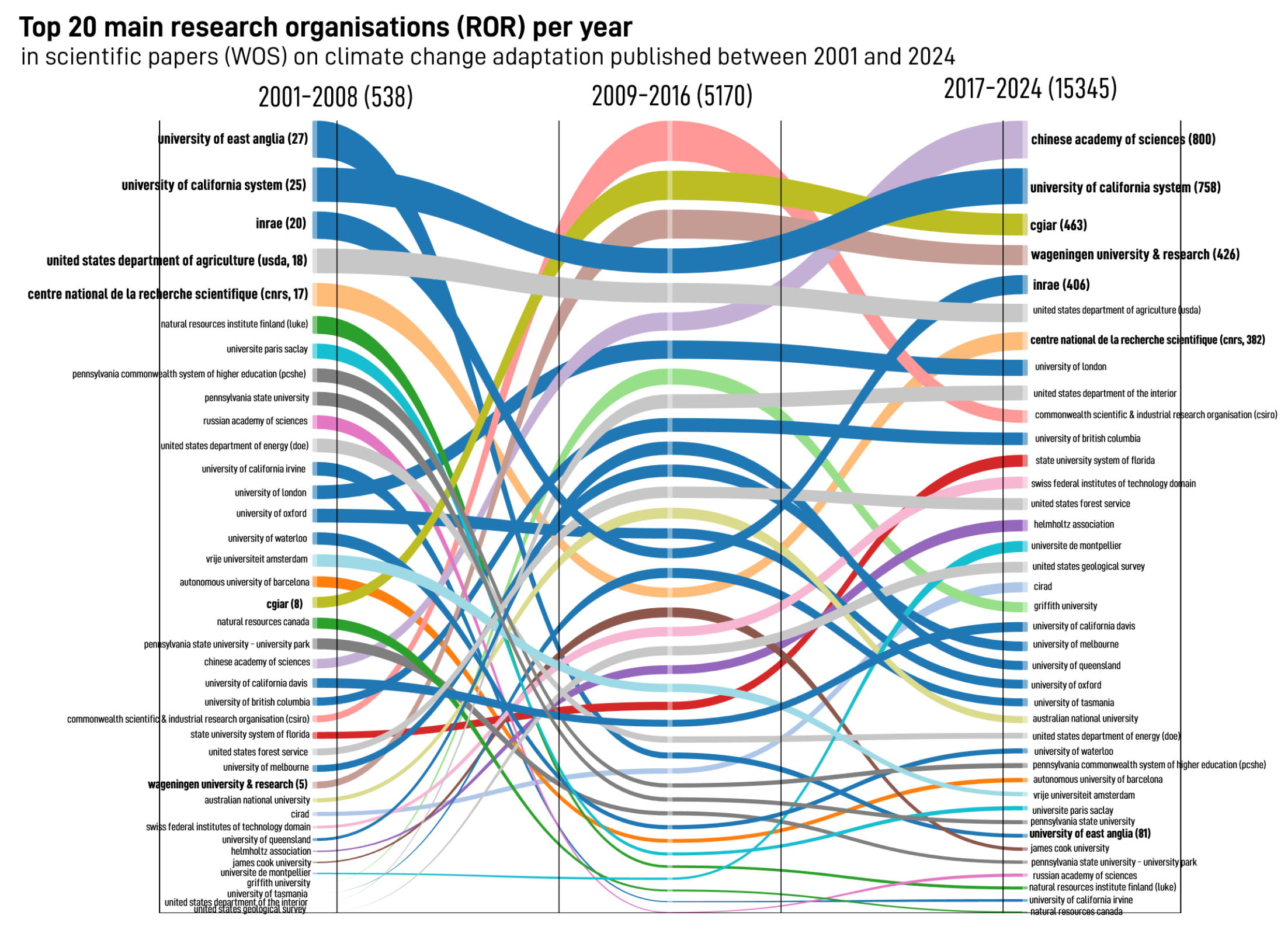
A remarkable position for French research institutes (CNRS, INRAE, with the effect of having multiple parent organizations per laboratory), along with a rise of the Chinese Academy of Sciences in the most recent period.
Top 200 research organizations’ closest collaboration network
Research organizations’ communities tend to structure themselves nationally around one or several major research institutions in each country. In this regard, French research organizations appear as central actors, indicating a wide geographical distribution of their international collaborations (along with others such as the University of British Columbia, Harvard University, etc.).
Which organizations
French doctoral theses: identifying leading universities and institutional linkages
Where
Which organizations
- Scientific publications: identifying leading organizations and collaboration patterns
- French doctoral theses: identifying leading universities and institutional linkages
Ranking of top 10 organizations (dashboard)
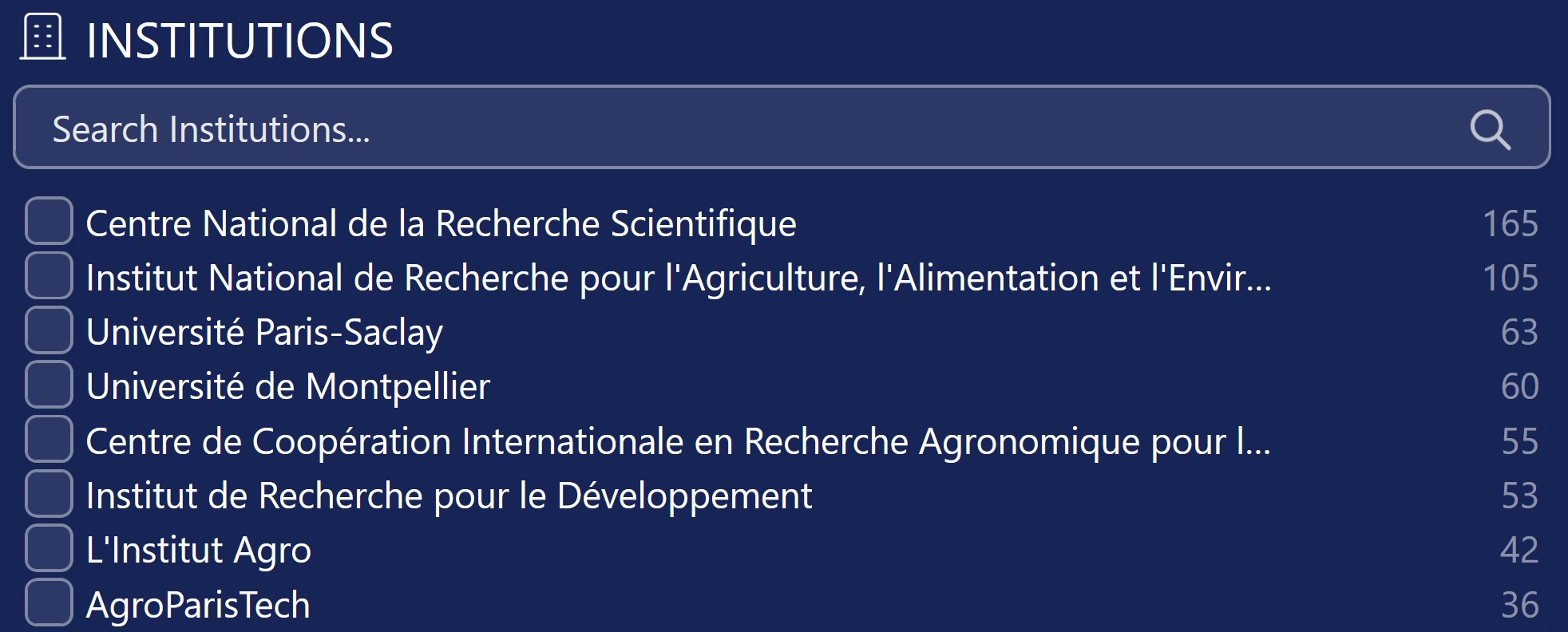
Université Paris-Saclay and Université de Montpellier are the top two French universities in PhD thesis support.
Ranking of top 20 organizations per period
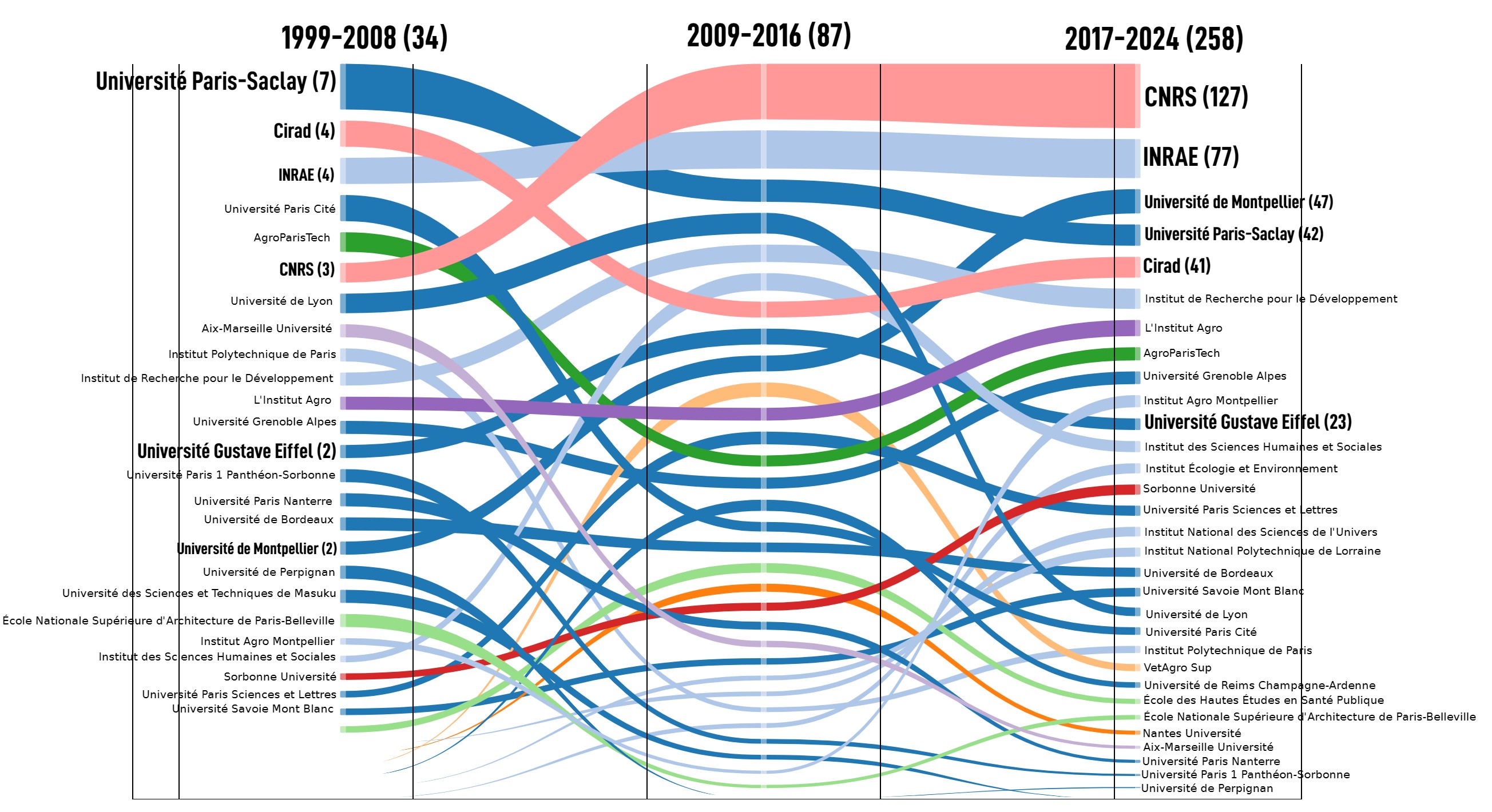
Université Paris-Saclay: the share of doctoral work on this topic decreases over time, while it increases for Université de Montpellier.
Top 200 network of closest institutional linkages
A bicephalous center structured around the two major research organizations (CNRS and INRAE), which serve as supervising institutions for laboratories. This is followed by communities with predominantly intra-regional relations.
Which topics
Scientific publications: tracing the evolution of research topics
Where
Which organizations
Which topics
- Scientific publications: tracing the evolution of research topics
- French doctoral theses: tracing the evolution of doctoral research topics

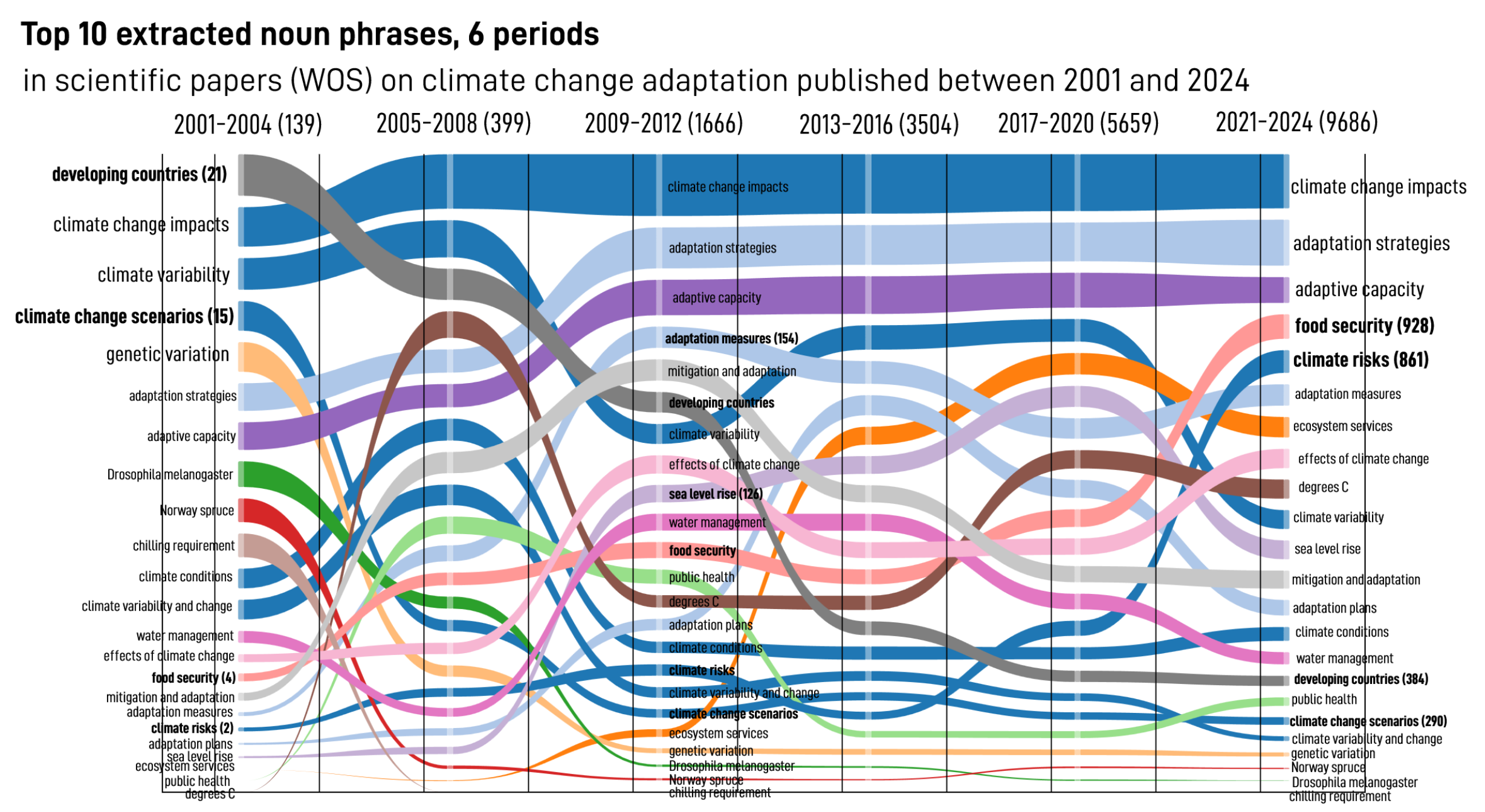
The share of work on scenarios, climate-change modeling, and developing countries decreases, while research on adaptation measures, risks, and food security becomes proportionally more prominent.
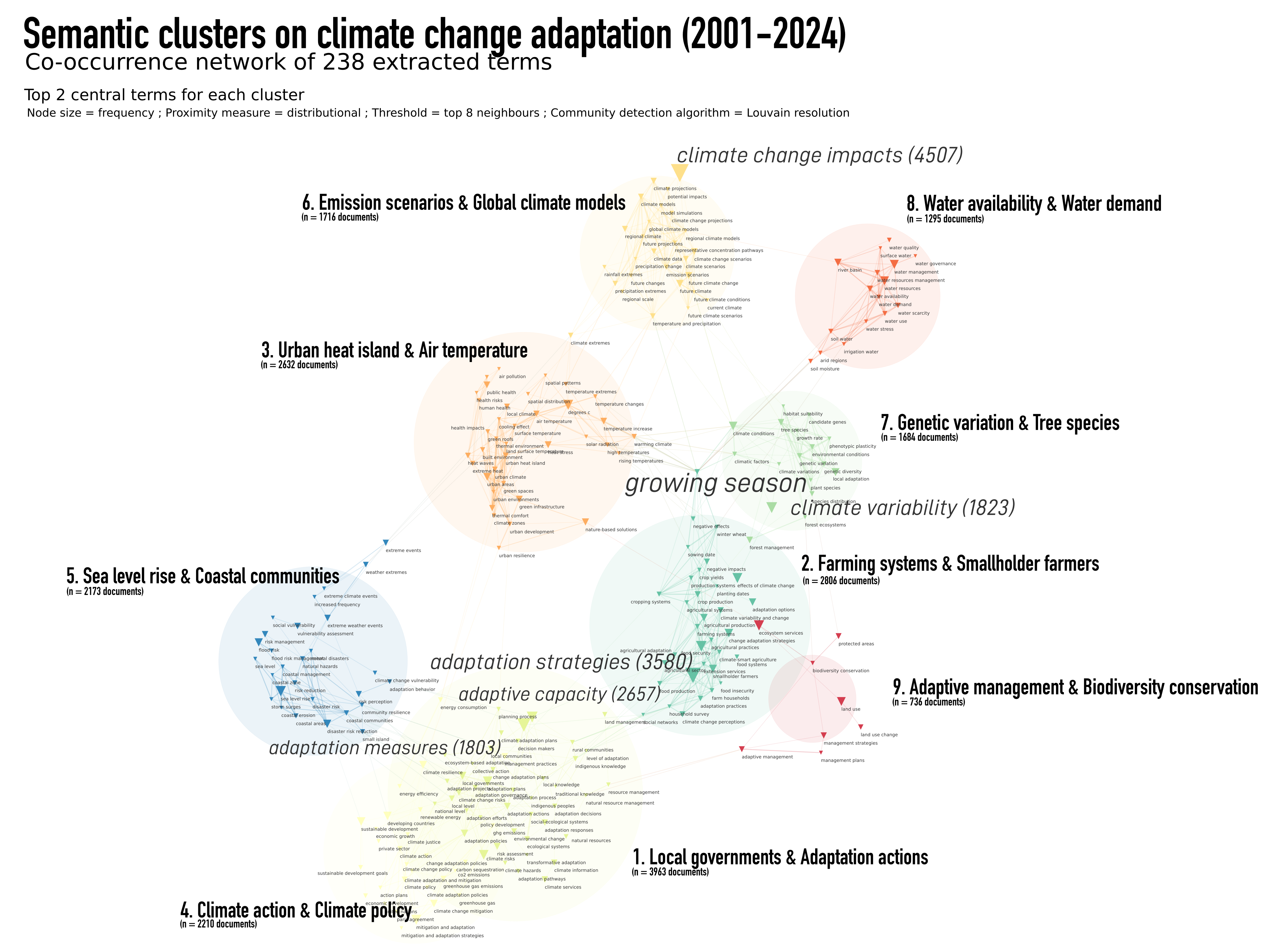
| Macro topics | Cluster numbers |
|---|---|
| Biophysical impacts and climatic processes | Clusters 3, 6, 7, 8 |
| Socio-agricultural systems and territorial vulnerabilities | Clusters 2, 5, 9 |
| Governance, policy, and adaptation strategies | Clusters 1, 4 |
Continuum : climate models → impacts → vulnerabilities → adaptation actions
The map shows three macro-thematic groups
1. Climate change impacts (top area)
Includes:
- climate change impacts
- urban heat island / air temperature
- water availability
- emission scenarios and global climate models
- genetic variation and tree species
This macro-thematic gathers research documenting the biophysical effects of climate change.
2. Socio-ecological systems and agriculture (right and center)
Includes:
- growing season
- climate variability
- farming systems and smallholders
- biodiversity / adaptive management
This macro-thematic connects climate, interannual variability, and agro-ecological dynamics.
3. Governance, policy, and concrete adaptation (bottom and left)
Includes:
- local governments and adaptation actions
- adaptation strategies / adaptive capacity
- climate action and climate policy
- sea level rise and coastal communities
The normative and operational core of research on sociopolitical responses to climate change.
Overall interpretation
The field is strongly structured by agriculture and climate impacts.
- Central clusters connect agricultural production ↔ climate ↔ seasonality.
Local governance plays a important role.
- It is the largest cluster: publications on planning and adaptation policies have largely been developed.
Biophysical impacts are not isolated: they feed sociopolitical clusters.
- e.g., urban heat island ↔ urban adaptation,
- water availability ↔ agriculture.
Biodiversity remains peripheral but connected.
- It represents a specialized disciplinary niche within adaptation research.
Overviw of the evolution of the topics since 2001
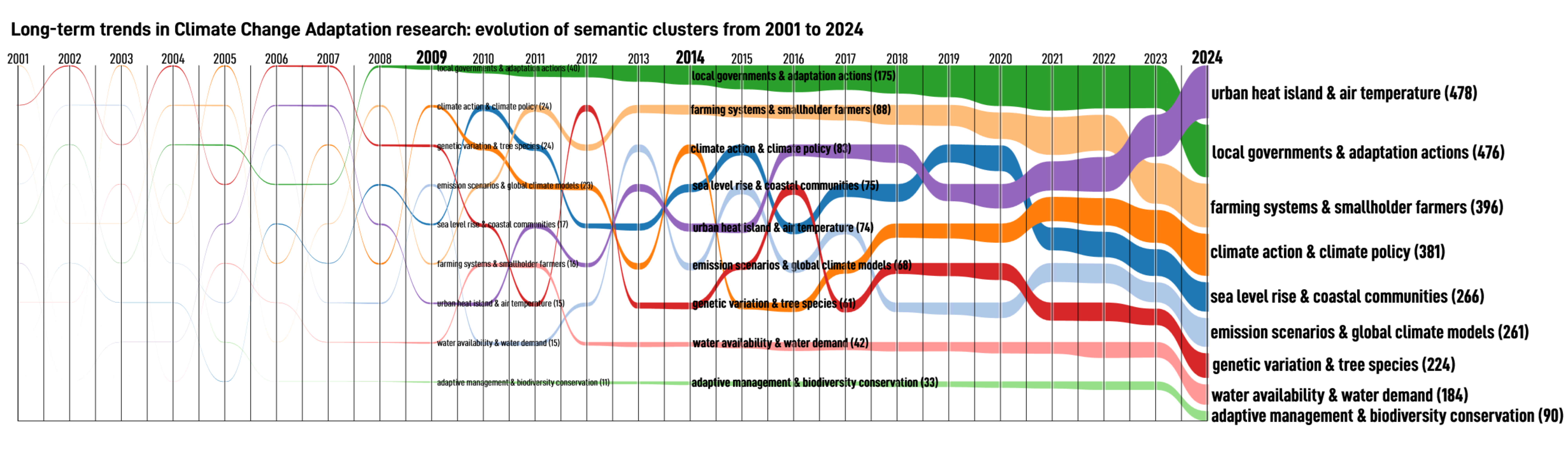
Focus on the last period, 2009-2024
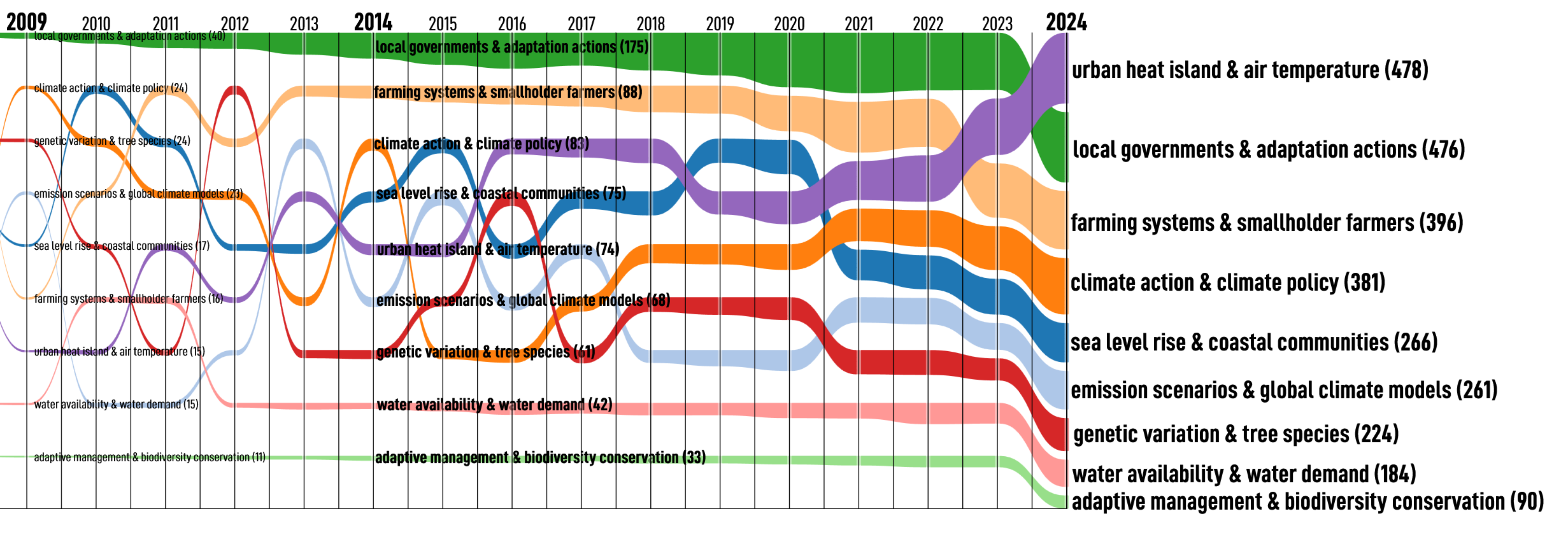
| Trend | Description |
|---|---|
| Rise of urban heat studies | Becomes the top cluster by 2024. |
| Institutionalisation of local adaptation governance | Strong, steady growth since 2010. |
| Agricultural adaptation becomes central | Stable and major cluster across the decade. |
| Relative decline of model-centric research | Scenarios and GCMs no longer dominate. |
| Biodiversity stays peripheral | Slow growth, low integration with other clusters. |
| 2014–2017 as reconfiguration period | Major thematic reshuffling and consolidation. |
1. Rise and consolidation of applied, territorial, and socio-political themes (2010 → 2024)
Local governments and adaptation actions
- Starts modestly in 2009 but becomes one of the two dominant clusters by 2024.
- Shows a ** continuous rising trajectory**, suggesting long-term institutionalisation of adaptation planning.
- Reflects diffusion of regional climate strategies.
Climate action and climate policy
- Increases significantly.
- Gains importance after 2015, likely linked to the Paris Agreement era.
Governance-oriented themes become a pillars of adaptation research after 2015.
2. Agricultural and food-system themes gain prominence and stability
Farming systems and smallholder farmers
- Starts small but becomes a top-three cluster by 2024.
- Reflects consolidation in global South contexts (vulnerability and resilience).
Links with climate variability themes
- Increasingly framed through risk, uncertainty, and seasonal forecasting.
Agriculture becomes the central socio-ecological domain of adaptation research.
3. Environmental impact and biophysical clusters diverge
Urban heat island and air temperature
- largest cluster in 2024.
- Rise 2014–2015.
- Linked to heatwaves, urbanisation, satellite remote sensing.
Sea level rise and coastal communities
- Steady growth.
Emission scenarios andclimate models
- Peak 2014–2016, then relative decline.
- Shift to applied, sectoral adaptation research.
Genetic variation and tree species
- Gradual rise, specialised niche.
Water availability and demand
- Mid-tier, slight growth.
Shift from macro biophysical modelling to applied urban/sectoral studies.
4. Biodiversity and adaptive management (small but persistent)
Adaptive management and biodiversity
- Slow but stable growth, little thematic merging.
- Remains peripheral to broader adaptation agendas.
Biodiversity adaptation grows, but stays secondary to human-centred themes.
The landscape in 2024: a more intervention-oriented field
Dominant clusters in 2024:
- Urban heat island and air temperature
- Local governments and adaptation actions
- Farming systems and smallholder farmers
- Climate action and climate policy
These represent applied, societal challenges rather than purely scientific modelling.
Earth-system modelling and biodiversity remain relevant but no longer central.
The field’s centre of gravity shifts toward applied,
human-centred, policy-relevant adaptation research.

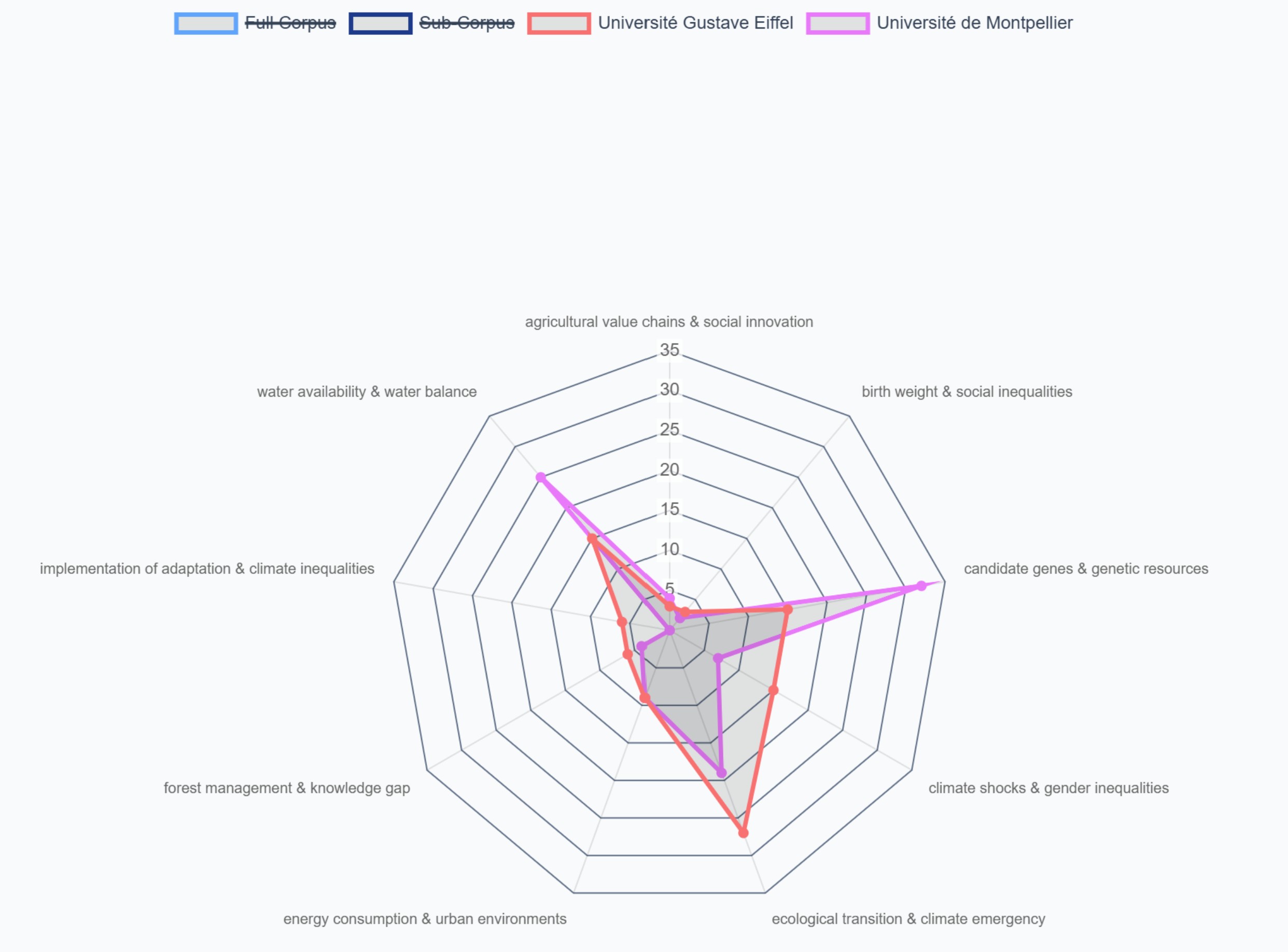
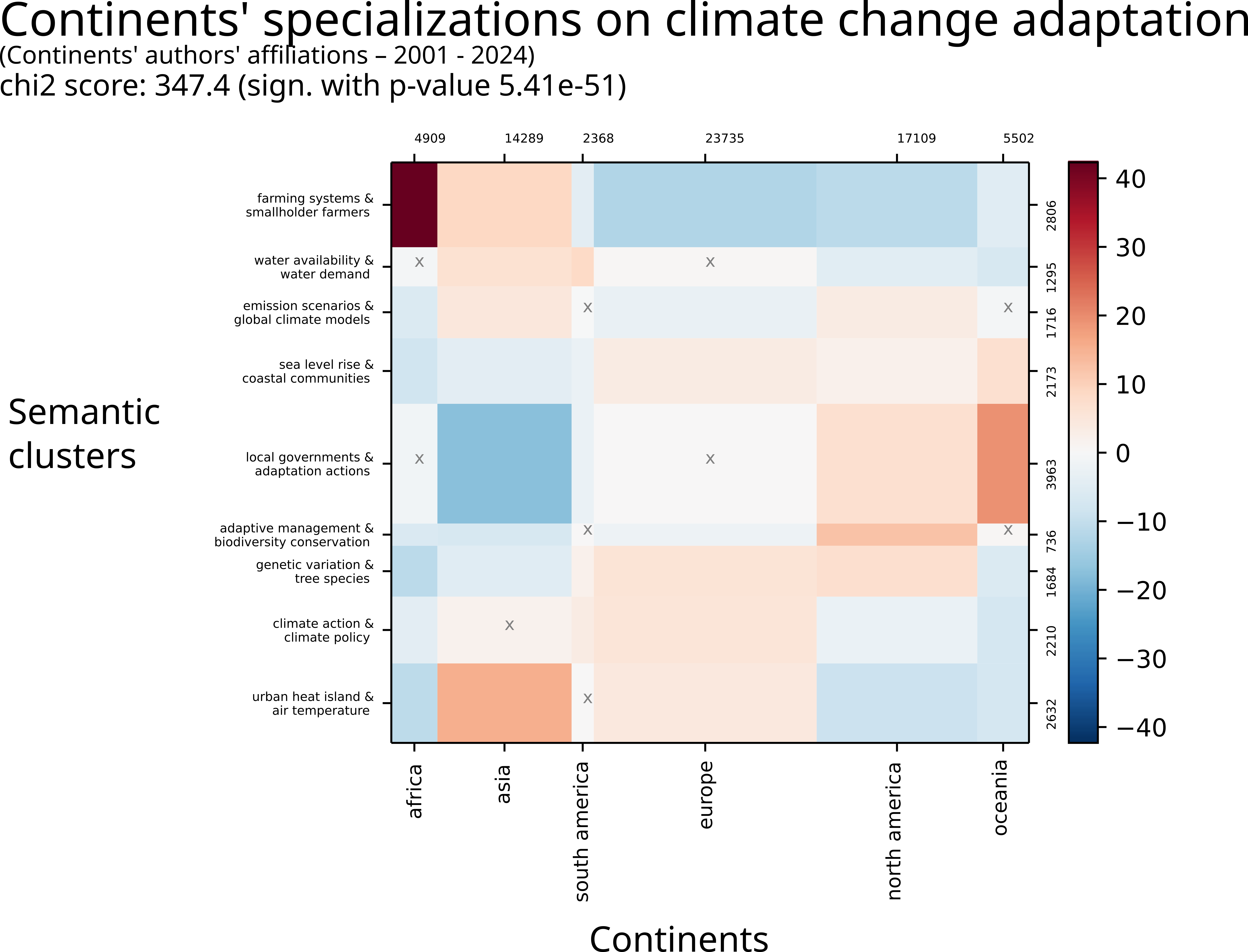
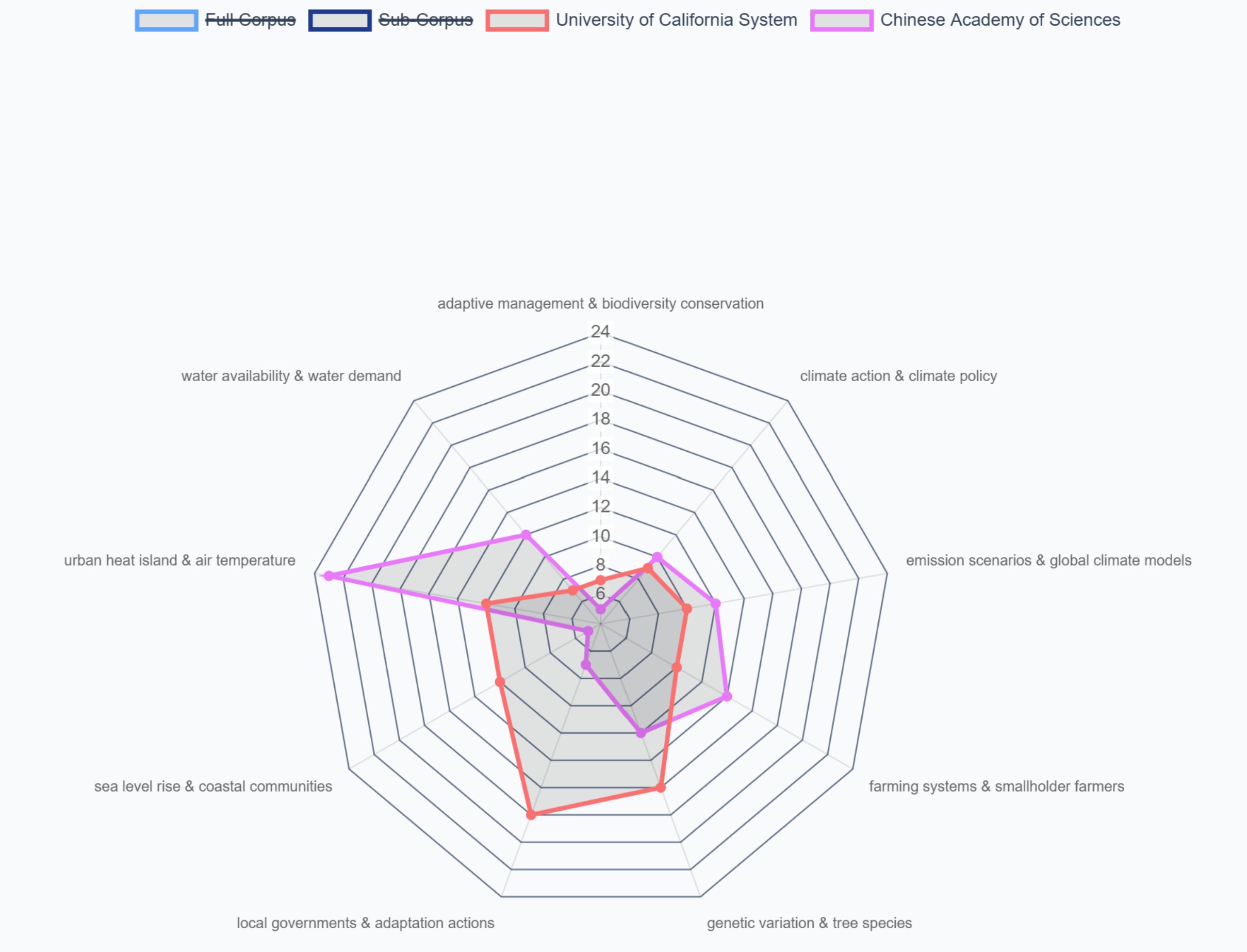
The thematic profiles of the two largest research organizations working on climate change adaptation (dashboard)
Which topics
French doctoral theses: tracing the evolution of doctoral research topics
Where
Which organizations
Which topics
- Scientific publications: tracing the evolution of research topics
- French doctoral theses: tracing the evolution of doctoral research topics
Key concepts evolution in PhD theses from 1999 to 2024
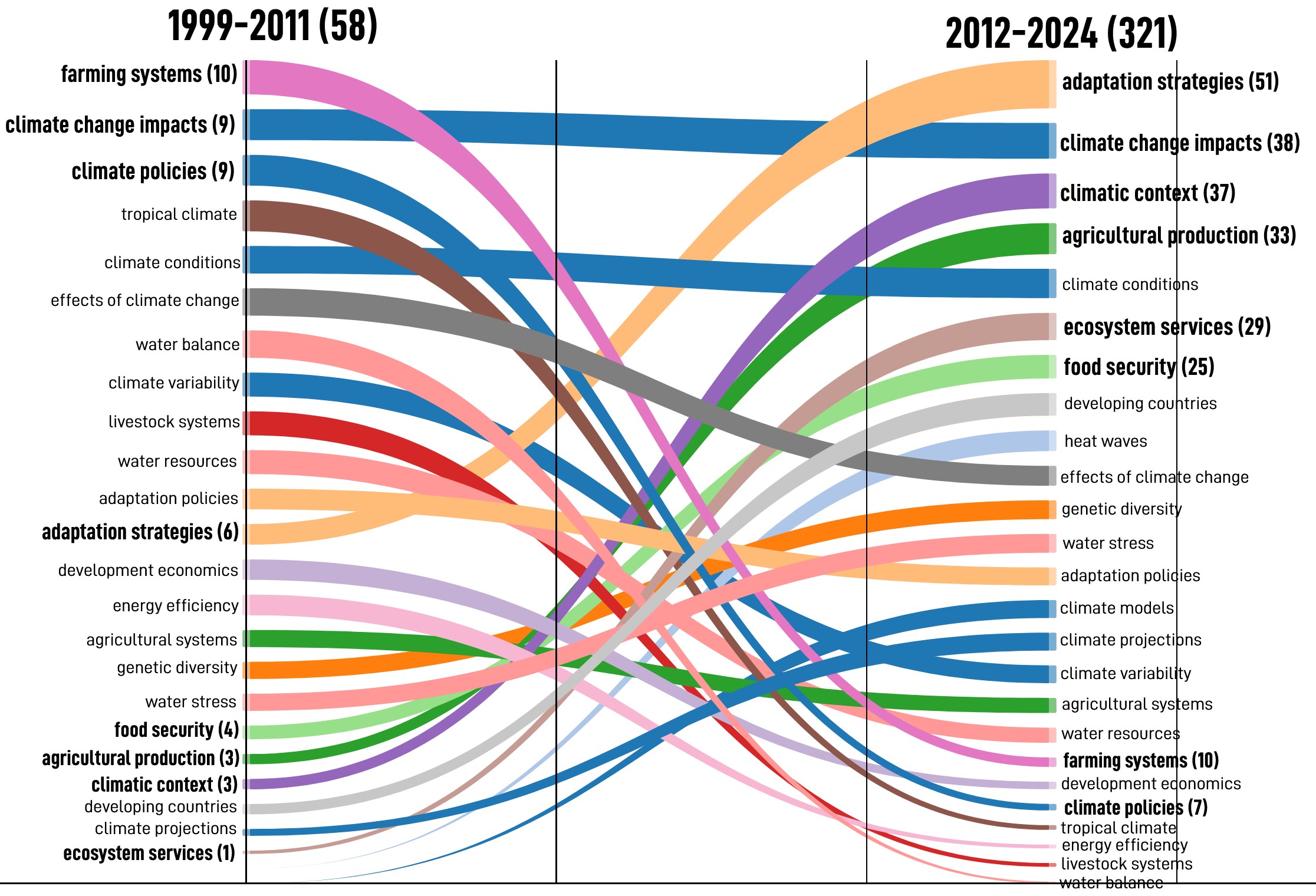
Large and recent diffusion of the research field adaptation in theses
Recentring of concpets: shift from agro-climatic approaches to an integrated socio-ecological perspective (adaptation, ecosystem services, food security)
Continuities: climate impacts remain central.
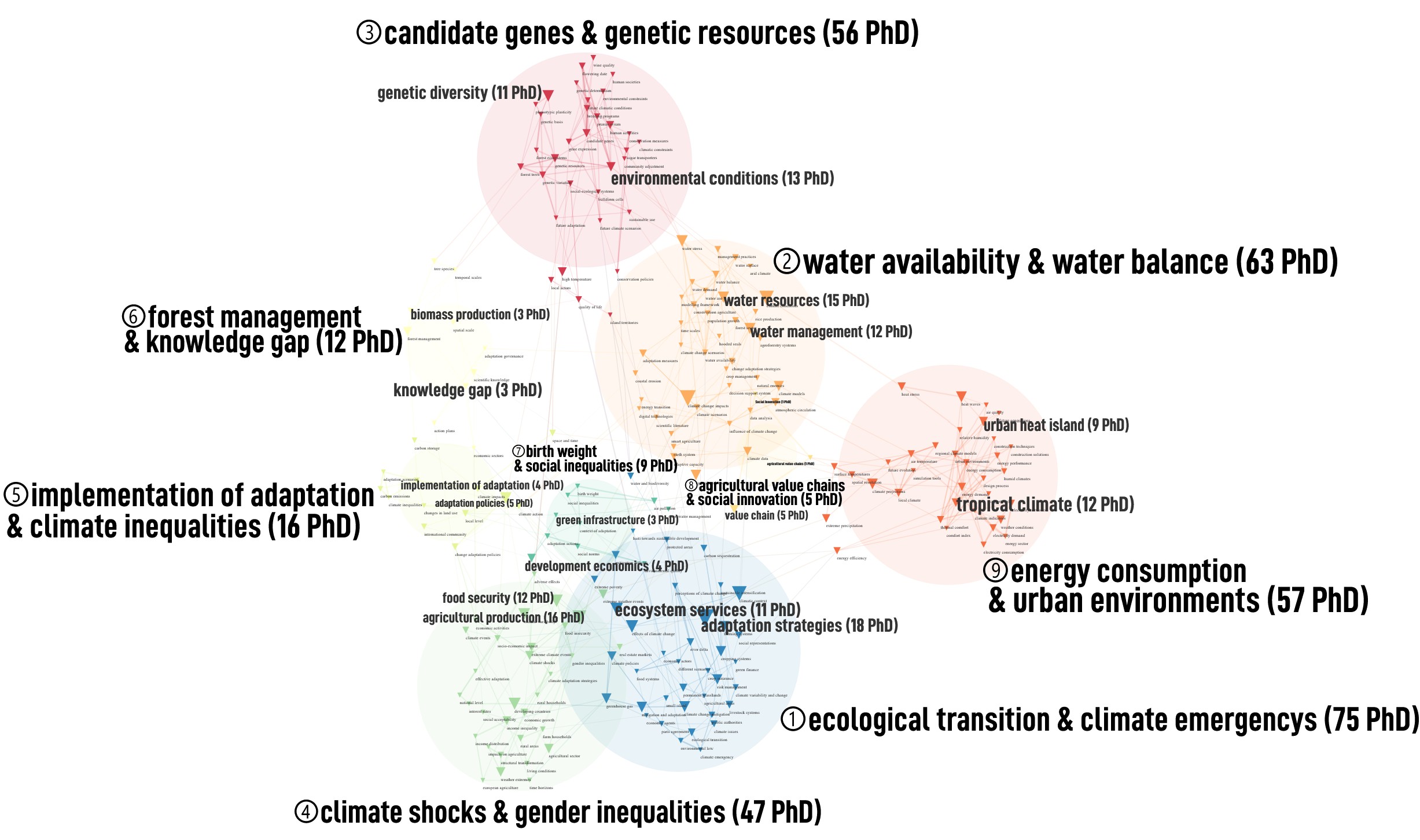
| Macro topics | Cluster numbers |
|---|---|
| Social and socio-economic inequalities under climate stress | Clusters 4, 5, 7 |
| Ecological transition, ecosystems, and resource management | Clusters 1, 2, 6, 8 |
| Urban and biophysical adaptation mechanisms | Clusters 3, 9 |
A central axis connecting:
ecological transition, adaptation strategies,
social inequalities, food security, and water management.
① Ecological transition and climate emergencies (75 PhD)
Largest cluster: central in the network.
Concepts include: climate emergencies, adaptation strategies, food systems, ecosystem services, development economics, carbon sequestration
This cluster acts as the conceptual core of the PhD landscape, bridging ecological science, sustainability science, and socio-economic studies.
② Water availability and water balance (63 PhD)
A major applied science cluster focused on: water resources, irrigation and water management, watershed modelling
Water concept remain a pillar of adaptation research, both technically (modelling) and socio-economically (resource governance).
The cluster connects strongly with agriculture, tropical climate, and urban heat topics.
③ Candidate genes and genetic resources (56 PhD)
A biological and genetic cluster dealing with: plant genetic diversity, environmental genomics, forest
This cluster shows that adaptation at the biological level is a significant domain of French PhD research.
It forms a specialised but sizeable niche oriented toward breeding, genetic markers, and evolutionary responses to climate stress.
④ Climate shocks and gender inequalities (47 PhD)
A social-science-oriented cluster covering: gendered impacts of climate shocks, vulnerability and social inequalities
This is one of the most distinctive features of French PhD research: a strong engagement with social justice, and equity in climate adaptation. It is less visible in global scientific corpora; indicating a unique French emphasis.
⑤ Implementation of adaptation and climate inequalities (16 PhD)
This cluster is connected to: adaptation policies, economic sectors, action plans
It forms a policy–science interface, showing strong links to cluster ④ (inequalities) and cluster ① (transition).
It focuses on how adaptation is actually implemented in society.
⑥ Forest management and knowledge gap (12 PhD)
A smaller but consistent cluster involving: forest ecology, biomass production, knowledge gaps, ecosystem responses to climate pressures
It bridges biological adaptation (cluster ③) and ecosystem service perspectives (cluster ①).
⑦ Birth weight and social inequalities (9 PhD)
A small but coherent social-science cluster dealing with: health impacts of climate, neonatal health, socio-economic inequalities
Its presence highlights the emergence of climate–health linkages in French PhD research.
⑧ Agricultural value chains and social innovation (5 PhD)
Includes: value chains and agri-food systems, rural social innovation
This cluster creates a bridge between water management, development studies, and ecosystem services.
⑨ Energy consumption and urban environments (57 PhD)
Second major applied cluster, focused on: urban heat island, energy consumption, tropical climates, air quality, adaptation of buildings and cities
This reflects a strong interest in urban resilience, energy transitions, and climate impacts in densely built environments.

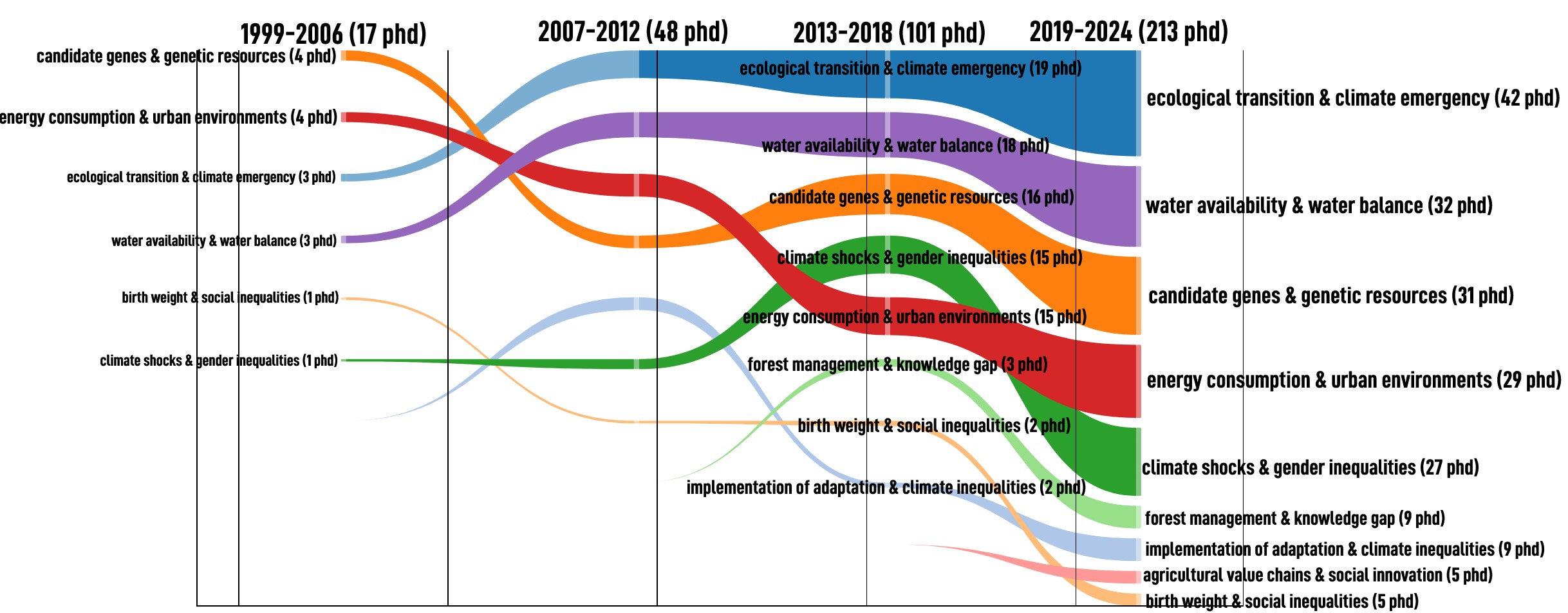
A shift from biophysical dominance toward socio-ecological and socio-political research: social inequalities, gender, governance, and transition become major topics after 2013.
The field becomes highly interdisciplinary after 2013, combining ecology, social sciences, and public policy.
T1-T2: ecological transition becomes the conceptual backbone of the doctoral field.
T2-T3: urban adaptation and energy use become major applied research areas, responding to real-world challenges (heatwaves, urbanisation).
T3-T4: biological and hydrological adaptation remain strong, but are no longer the only core topics.
T4: emerging research fronts, implementation of adaptation and climate inequalities, agricultural value chains and social innovation, forest management and knowledge gap
Cities specialisation
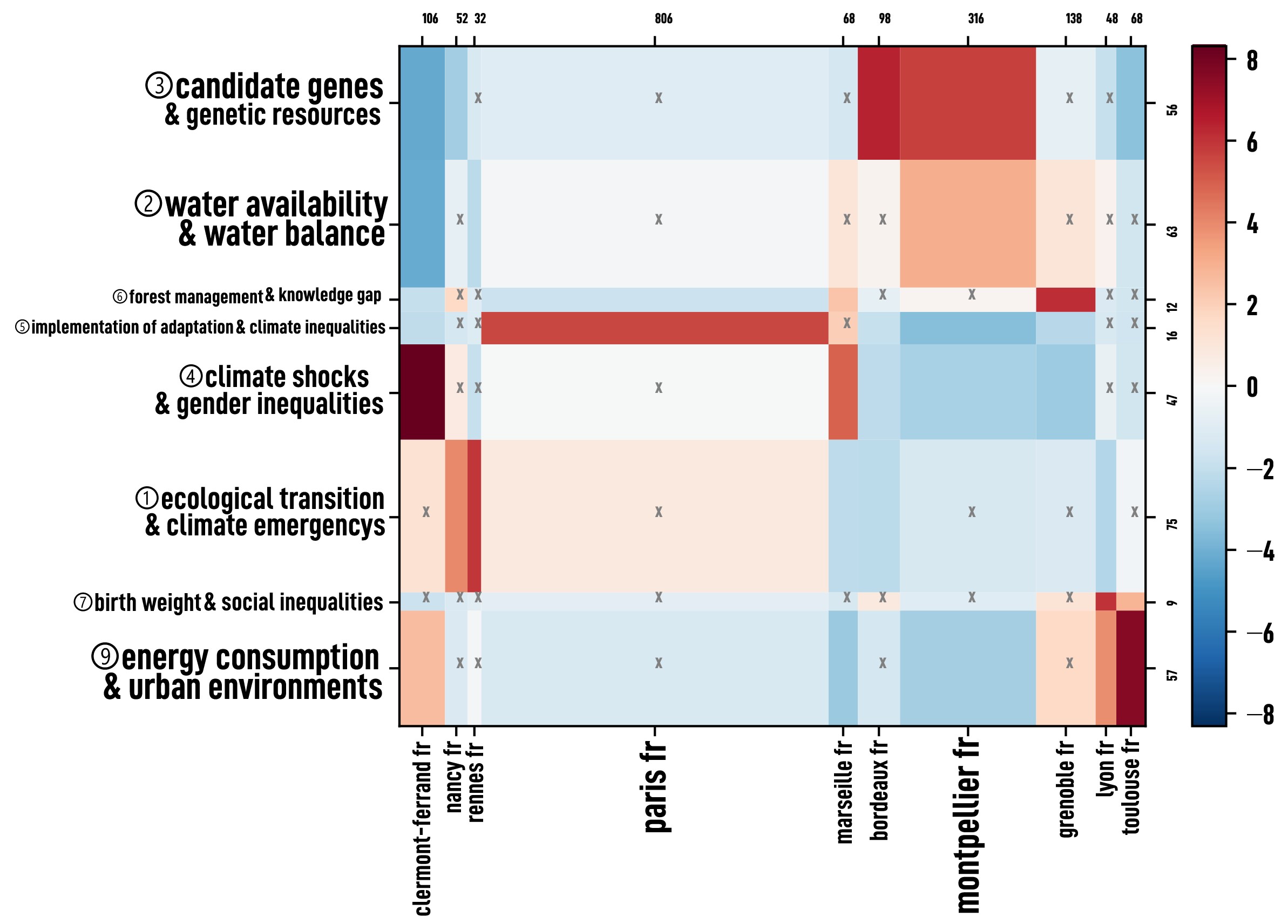
Montpellier is the national city for genetics and water-related adaptation research.
Paris shows a research specialization on questions of implementations and inequality studies.
PhD theses in Lyon and Toulouse focused on the health impacts of climate change, socio-economic inequalities and transitions
Medium-sized cities contribute niche expertise (Forest management and knowledge gap in Grenoble...).
The thematic profiles of the two research organizations (dashboard)